Ticket to Ride®
- 4.1
- Rating
- 50.00K
- Installs
- $4.99
- Price

 Analysis by App-foxy
I approached Ticket to Ride® as the kind of board game I could open when I wanted something more thoughtful than a quick arcade round, but less demanding than a long strategy session. The mobile version brings the familiar railway-building idea to Android and iOS in a compact format, with matches against artificial intelligence or other players online. It is a paid board game from Marmalade Game Studio, and its appeal depends less on flashy presentation than on how well it turns a tabletop decision-making experience into something comfortable on a phone.
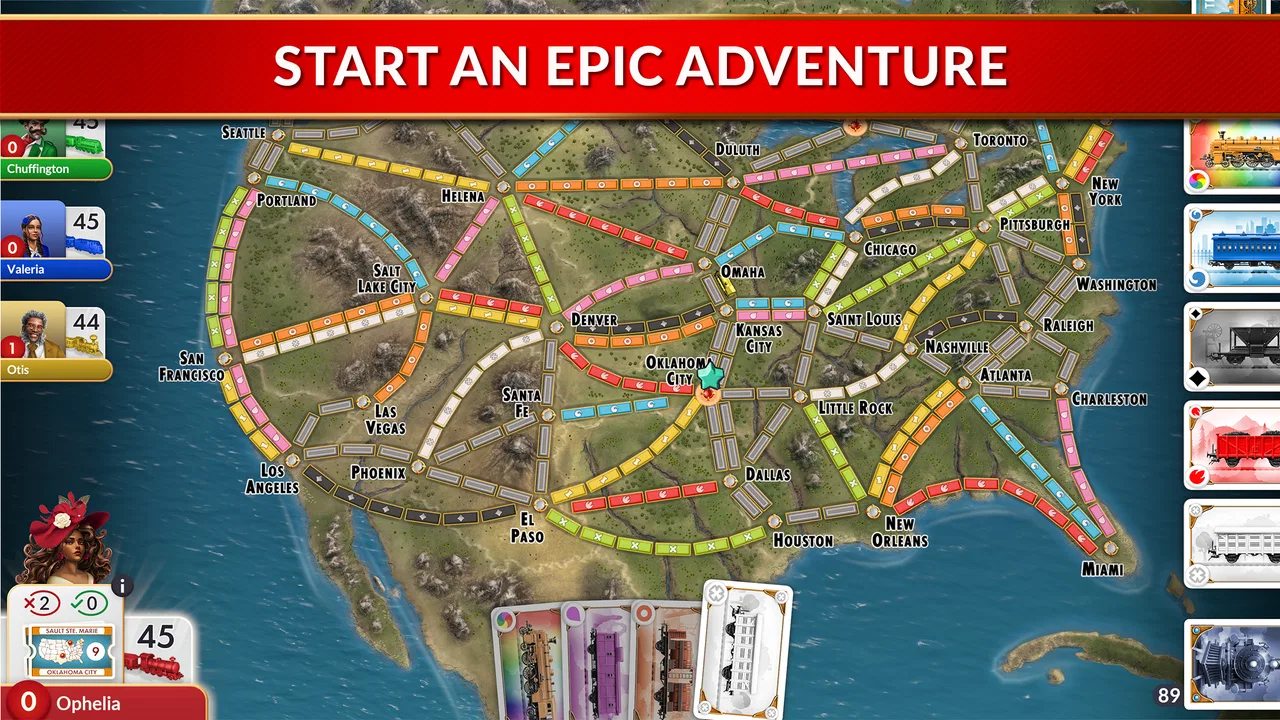
My first impression was that this is best understood as a digital board-game adaptation rather than a casual game with a railway theme. You collect cards, claim routes, and try to connect destinations while watching what everyone else is attempting. The rules are approachable, but the decisions become sharper once opponents start blocking useful paths. That makes it suitable for families, existing board-game fans, and players who enjoy planning several turns ahead.
The important catch is that the experience can feel less immediate than a free-to-play mobile title. The game costs $4.99, and it also includes optional in-app purchases ranging from $1.99 to $29.99 per item. I would therefore recommend deciding what kind of player you are before installing it: if you want a polished digital board game you can return to repeatedly, the purchase is easier to justify; if you only want a free five-minute distraction, this is probably not the right fit.
You May Also Like

 Blood Strike: 2.5 Anniversary
Blood Strike’s Loadouts Turn Every Drop Into a Tactical Gamble
A close look at Blood Strike’s custom loadouts: how fast access to signature weapons reshapes its battle royale rhythm, rewards preparation, and narrows the gap between fights.

 Pandora - Music & Podcasts
Pandora’s Music Is Easy to Start, but Harder to Recover
Pandora’s strength is its low-effort path from a seed to a station. Its weak spot is how much confidence it asks you to place in connection, setup, and quiet recovery.

 8 Ball Pool
 Is Built on Rivalries, Rematches, and Routine
A close look at the rivalries, rematches, shared routines, and unanswered safety questions that turn a quick pool match into a persistent mobile community.

 Samsung Music
’s Quiet Strength Is Playing What You Already Own
Its reach comes less from spectacle than from dependable access to a personal library. That simplicity is both the app’s strongest retention engine and its ceiling.

 AccuWeather: Weather Radar
AccuWeather Review: A Quick, Clear Forecast for Everyday Decisions
For everyday plans, the best forecast is the one you can understand quickly. AccuWeather makes rain timing, radar, and local conditions easy to act on, with a few trade-offs.

 Hill Climb Racing
Why Hill Climb Racing Still Turns Crashes Into One More Run
A tiny car, a bumpy hill and one more upgrade: Hill Climb Racing keeps resurfacing because its simple chaos makes every near-miss feel personal.
More From Our News Desk
View All News


Getting comfortable with the board and the first match
I ease into the first match by treating the board as a map of choices, not a checklist of routes to claim. I read my destinations, trace more than one possible connection, and watch which areas begin to attract attention; that gives me room to adapt if a key link disappears. Once that basic rhythm feels natural, it becomes easier to spot the decisions that matter beyond simply collecting cards.
Where new players usually get stuck
The central challenge is not learning what a train route is. It is learning how to balance visible progress against hidden intentions. At the start of a match, it is tempting to collect cards for the longest route you can see. In practice, that can leave you holding a plan that becomes impossible when another player claims one important connection first.
I found it more useful to treat destination goals as flexible priorities rather than a promise to follow one perfect line. If two destinations can be connected through several broad corridors, I keep more than one option open. If a goal depends on a narrow passage, I pay attention to that passage early, even when claiming it is not the most valuable move on the board.
This is also where the artificial intelligence can make the game feel different from a relaxed family session. Computer opponents do not need social explanations or reminders, and their choices can make the board tighten quickly. A beginner may interpret an opponent’s route as random when it is actually cutting off a useful junction. I recommend watching which colors and regions other players repeatedly collect before assuming they are not competing for the same area.
Online play creates a separate source of friction. A match is much more enjoyable when everyone understands the turn rhythm and stays engaged. If a player takes a long time between moves, the strategic flow breaks, especially when you are trying to remember which routes remain available. This is not a flaw unique to this game, but it matters more here because a single missed route can change the value of an entire hand of cards.
Setup checks that save time
Before starting, I would make sure the device is running at least Android 6.0 or the supported equivalent on iOS, then allow the installation to finish completely before judging performance. A board game can look simple, but it still needs to load the board, cards, menus, and online components correctly. Opening it immediately after an interrupted installation is an easy way to mistake a setup problem for a game problem.
I also recommend checking that the correct store account is active before paying for the game or any optional content. This is particularly useful on a shared family device, where one person may install the app and another may later try to restore access. Keeping the purchase process tied to the account that normally manages apps avoids unnecessary confusion.
For online matches, I prefer starting from a stable connection rather than switching between Wi-Fi and mobile data during the opening turns. A brief connection change can be enough to interrupt a lobby or leave the player unsure whether a move was registered. If the game appears stuck, I first wait a moment, check the connection, and reopen the match only after confirming that the app is no longer responding.
Screen orientation and notification habits are worth considering too. I turn off distractions before beginning a longer match because a board game loses its rhythm when I repeatedly leave the screen. On a smaller phone, I also take a few seconds to inspect the route colors and destination information before making the first move. That small pause is more useful than rushing into an early claim and then discovering that I misunderstood the connection I needed.
A practical opening workflow
My preferred opening routine is simple. I read the destination objectives first, identify the shortest realistic connection between them, and then look for alternative links that keep both objectives alive. I do not immediately spend every useful card. Instead, I ask whether a route is strategically important because it connects two areas, blocks an opponent, or merely gives me points.
That distinction produces one of the most valuable habits in the game: do not confuse a high-value route with a high-value move. A long route may score well, but claiming a modest connector can protect an entire plan. Conversely, blocking another player can feel satisfying while leaving your own objectives unfinished. I use blocking as a secondary benefit, not as the main reason to spend a scarce set of cards.
When drawing cards, I try to preserve uncertainty. Taking several cards of one color may signal my plan to human opponents, while a more varied hand gives me room to adapt. This is not about hiding every intention; it is about avoiding a situation where one unavailable color destroys the only route I can still use.
For a first match against the AI, I would choose a conservative plan: complete one reliable connection, learn how quickly the board fills, and only then attempt a more ambitious network. New players often lose not because they lack points, but because they hold too many unfinished goals until the available routes disappear.
Recovering when a plan goes wrong
Every match eventually includes a bad draw, a blocked route, or a destination objective that no longer looks sensible. My recovery method is to stop defending the original plan emotionally. I review the remaining open routes, estimate which objective is still practical, and build a shorter backup connection instead of spending several turns chasing an unlikely one.
This is especially important near the end of a match. A player can be ahead on visible route points and still lose because an unfinished destination objective carries a penalty. I therefore start checking completion risk before the board becomes crowded. If one objective is secure and the other is in danger, I prioritize a realistic partial network rather than gambling everything on a dramatic final route.
When an online match seems frozen, I avoid repeatedly tapping the same control. I give the turn a moment, verify whether the connection is still active, and then restart the app if the screen clearly stops responding. After reopening, I check the match state before attempting another action. Repeated inputs can create more uncertainty than a patient recovery, particularly when the original action may already have been accepted.
If a purchase or optional item does not appear immediately, I use the same cautious approach: confirm the account, wait for the transaction to finish, and avoid buying again in frustration. I would also restart the app only after the store process has completed. This is general mobile troubleshooting, but it is sensible here because the game combines a paid download with optional purchases.
When the app is not the cause
Some disappointing sessions are really a mismatch between the game and the situation. Ticket to Ride is not ideal when I want a completely passive experience. Even against the AI, I need to remember routes, evaluate opponents, and accept that a good plan can be disrupted. If I am tired or multitasking, I am more likely to make a poor decision and blame the interface for a strategic mistake.
Online play can also expose problems outside the game itself. An unstable home network, aggressive battery management, background app restrictions, or a device with very little free storage can interrupt almost any mobile title. Before concluding that the game is unreliable, I would close demanding apps, check the connection, and make sure the phone is not limiting background activity during a match.
There is a similar distinction with perceived difficulty. The AI may seem unfair when it claims a route I wanted, but that is often a sign that I waited too long to secure a critical junction. I find the game more satisfying once I treat opponents’ actions as information. A sudden claim in one region tells me something about their objectives, even if I cannot know the exact destination cards they hold.
The age rating of Everyone makes the game broadly suitable for family use, but suitability still depends on the group’s expectations. Younger players may understand the route-taking rules quickly while needing help with probability, blocking, and the consequences of unfinished objectives. Adults looking for a serious competitive board-game session may enjoy it, although a dedicated tabletop gathering offers more conversation and physical presence than a phone screen.
How it compares with familiar alternatives
Compared with a traditional physical copy, the mobile version removes setup, sorting, counting, and the need to find enough people in the same room. That is its strongest practical advantage. I can begin a match without spreading components across a table, and playing against the AI means I do not need to recruit a full group for every session.
The trade-off is that digital convenience changes the social character of the game. A physical board makes it easier to discuss rules, notice another player’s hesitation, and enjoy the shared ritual of drawing and placing pieces. On a phone, the experience is cleaner and faster to organize, but also more solitary unless the online mode is working well and everyone remains attentive.
Against lighter mobile board games, this adaptation asks more of me. It is not the best choice if I want a quick round with almost no planning. Against heavier strategy games, however, it feels more approachable because the core actions remain easy to understand even when the tactical choices become difficult. That middle position is exactly why I think it works for mixed groups: experienced players can look for efficient networks, while newcomers can learn through short, concrete decisions.
The rating sits at a 4.1 average from around 4.9 thousand ratings, with over 50 thousand installs, which suggests a meaningful audience without making the game feel like an anonymous mass-market utility. I would not treat those numbers as a substitute for personal preference, but they fit my impression of a specialized board-game adaptation that appeals most to people already interested in route-building and competitive planning.
Who should install it, and who should skip it
I would recommend it to someone who enjoys board games but wants a portable version for evenings, travel, or a quick solo match. It is also a good option for a household where players like different levels of competition: one person can practice against the AI while another prefers online play. The familiar railway theme makes the first steps approachable, while the limited space on the board gives repeat matches enough tension to remain interesting.
I would be more cautious about recommending it to someone who dislikes paying for mobile games, even though the initial price is clear. The optional purchase range may also make the overall cost feel less predictable for players who want every available addition. If you are looking for a completely free experience with no purchase decision, a different board-game app may suit you better.
It is also not my first choice for people who want real-time social interaction above all else. The game can connect players online, but a digital match cannot reproduce the atmosphere of sitting around a table. Likewise, players who prefer fast reflexes, constant animation, or short rounds with no long-term planning may find the measured pace too deliberate.
Long-term value and version expectations
The current version is 1.11.0, and I would keep the app updated before troubleshooting a problem. Updates can affect compatibility and stability, so testing an older installation after an issue appears may lead to the wrong conclusion. I also prefer not to begin an important online match immediately after an update; opening the app, checking the menus, and playing a short AI session is a sensible way to confirm that everything behaves normally.
For long-term use, the value comes from replaying the same basic framework with different objectives, opponents, and decisions rather than from constantly learning an entirely new ruleset. I enjoy that because improvement is easy to recognize: over time, I notice threats earlier, preserve more route options, and stop spending cards simply because I can afford a route.
One advanced habit I recommend is reviewing the final board after a loss. I look for the earliest turn where my plan became too narrow, not just the last route I failed to claim. Often the real mistake was keeping an objective alive after its supporting route had become unrealistic. That post-match review turns an ordinary defeat into useful practice and makes the AI mode more valuable than a simple placeholder for missing players.
My practical verdict
After spending time with it, I see this as a strong mobile home for a classic route-building board game, provided the buyer understands what they are getting. The rules are approachable, the decisions have real consequences, and the ability to play against AI or online makes it more flexible than a physical copy when I am alone or away from a table.
Its main weaknesses are practical rather than fundamental. Online sessions depend on a stable connection and engaged opponents, strategic mistakes can feel harsher than expected, and the paid entry point plus optional purchases will not appeal to everyone. The phone format also loses some of the warmth and conversation that make tabletop games special.
Still, I would recommend Ticket to Ride® to a friend who wants a thoughtful board game on a mobile device and is happy to plan rather than tap quickly. Start with the AI, protect flexible routes, treat destination objectives as priorities instead of chains, and troubleshoot calmly when a match appears stuck. If that style sounds enjoyable, this adaptation offers a convenient way to build railway networks whenever a full table and a group of players are not available.
For me, the deciding question is not whether it replaces the physical board completely. It does not. The better question is whether it preserves enough of the original tension to make a phone session worthwhile. In my experience, it does, especially for solo practice and planned online matches. I would skip it only if I wanted a free, ultra-fast game or a strongly social tabletop atmosphere; otherwise, it earns its place as a focused and replayable board-game app.
FAQs for Ticket to Ride®
01What is Ticket to Ride® and how is the game played?
Ticket to Ride® is a digital adaptation of the popular railway board game. Players collect colored train cards and use them to claim routes between cities on a map. The objective is to complete destination tickets while building the longest or most valuable railway network. Each turn is simple, but choosing routes carefully and anticipating opponents makes the game surprisingly strategic.
02Can I play Ticket to Ride® offline?
Yes, Ticket to Ride® can generally be played offline against computer-controlled opponents, which makes it useful for travel or situations without a reliable internet connection. However, some features may require an online connection, including multiplayer matchmaking, account-related services, downloadable content, updates, and certain social functions. It is best to launch the game online at least once after installation.
03Does Ticket to Ride® support multiplayer?
Ticket to Ride® offers multiplayer options, allowing you to play with friends or other players depending on the version and platform features available. Online matches may require an account or internet connection, while pass-and-play options can let people share one device. Before downloading, check whether your preferred map, multiplayer mode, and cross-platform support are included.
04Is Ticket to Ride® free to download and are there in-app purchases?
Ticket to Ride® is commonly offered as a paid mobile game, although pricing can vary by platform, region, promotions, and edition. Additional maps, expansions, or cosmetic content may be available through in-app purchases. The base game provides the core experience, but players who want more locations or scenarios should review the store listing carefully before buying.
05Is Ticket to Ride® suitable for beginners and younger players?
Yes, Ticket to Ride® is approachable for beginners because its rules are easy to learn: collect cards, claim railway routes, and complete destination tickets. The digital version usually includes tutorials or guided explanations that help new players understand the flow. Younger players can enjoy it too, although reading ability and strategic planning may affect how comfortably they play.
Pros
- Easy-to-learn rules make it accessible for casual players.
- Multiple maps offer varied routes and strategic challenges.
- Online multiplayer makes it easy to play with friends remotely.
- Short matches fit well into quick gaming sessions.
- Polished visuals clearly show routes
- trains
- and destination tickets.
Cons
- Some maps and features may require additional purchases.
- Random ticket draws can create frustratingly uneven objectives.
- Online matchmaking quality depends on the active player base.
- The best strategies can feel repetitive after extended play.
- Pass-and-play games require all players to share one device.

Ticket to Ride®
Gallery